In This Blog:
• What are We Comparing? | • Custom Website Pros & Cons | • WordPress Pros & Cons | • Website Builders (Wix, Shopify) pros & cons | • Side-by-Side Table | • Five Decision Questions | • The Migration Trap | • FAQ Guide
Table of Contents
- First — What Are We Actually Comparing?
- Option 1 — Custom Website (HTML, CSS & JavaScript)
- Option 2 — WordPress
- Option 3 — Website Builders (Wix, Squarespace, Shopify)
- Custom vs. WordPress vs. Builders — Side by Side
- Which Option is Actually Right for Your Business?
- Five Questions to Ask Yourself Before Choosing
- One More Thing — The Migration Trap Nobody Talks About
- Platform Selection Checklist
- Frequently Asked Questions
One of the most common questions we get from business owners planning a new website is: "Should I just use Wix? Or do I need WordPress? What is the difference between those and a custom-built website anyway?"
It is a genuinely confusing landscape — and the advice you get often depends on who you ask. Ask a Wix-using freelancer and they will recommend Wix. Ask a WordPress developer and they will recommend WordPress. Ask a custom development agency and they will tell you nothing else comes close.
In this guide, we give you the honest answer — one that acknowledges where each option genuinely works, where each falls short, and which one is right for your specific business situation.
No bias. No sales pitch. Just the clearest comparison we can give you.
First — What Are We Actually Comparing?
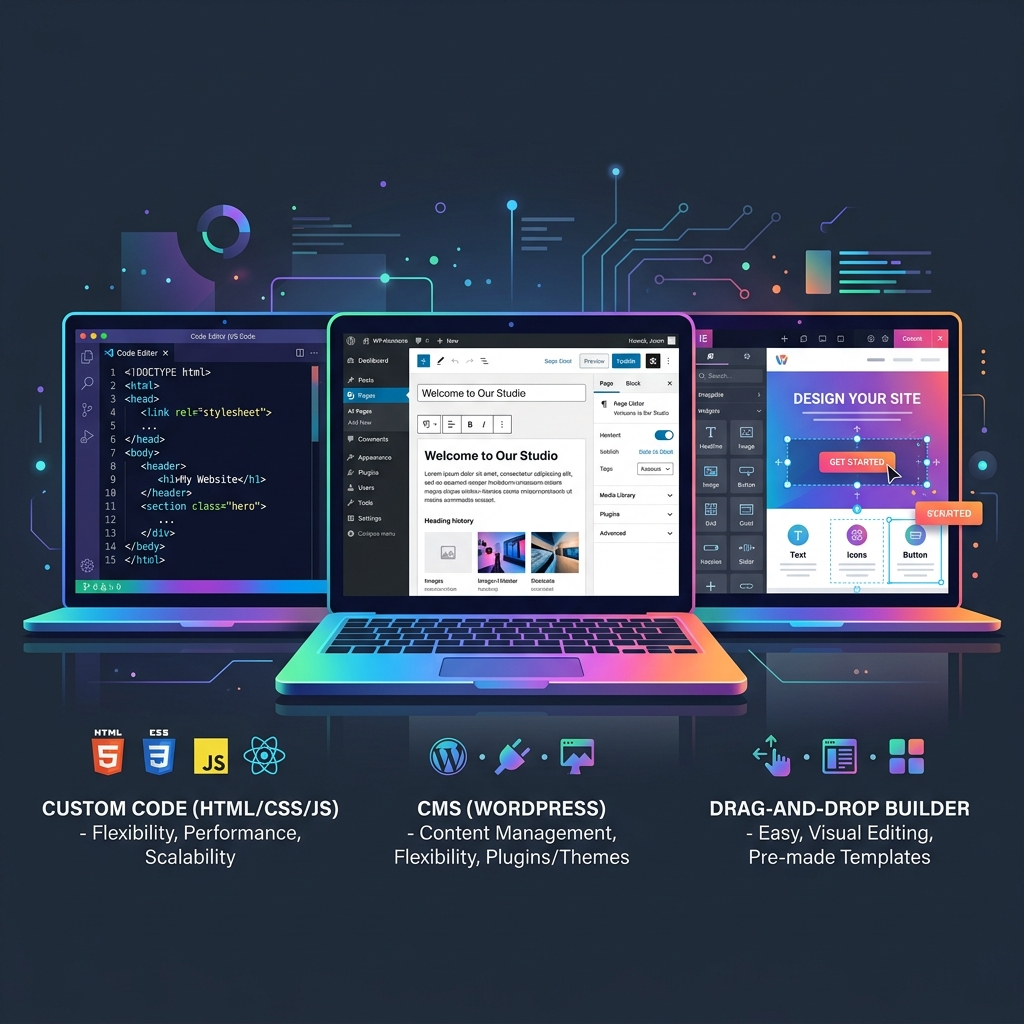
Before diving into the detailed differences, let's establish a clear baseline of what these three web technologies actually are:
Custom Website (HTML/CSS/JS)
A custom website is built entirely from scratch by a developer — using code written specifically for your business. There are no pre-built templates, and no content management systems (CMS) unless one is specifically custom-built. Every single element — design, structure, and functionality — is created uniquely for you.
This is the approach we use at our agency — pure, hand-coded HTML, CSS, and JavaScript, created to deliver exactly what each client needs without the weight of a platform they did not ask for.
WordPress
WordPress is the world's most popular Content Management System (CMS), powering approximately 43% of all websites on the internet. It is an open-source platform that allows developers to build websites using themes and plugins, with a backend dashboard that lets non-technical users update content themselves. It sits between fully custom and fully templated, offering significant flexibility with faster development times.
Website Builders
Website builders are all-in-one platforms that allow anyone — with or without technical knowledge — to build a website using drag-and-drop tools and pre-designed templates. Everything is hosted on the platform's own servers, and no coding is required. Popular options in India and globally include Wix, Squarespace, and Shopify (which is built specifically for e-commerce).
Option 1 — Custom Website (HTML, CSS & JavaScript)
A fully custom website is the right choice when your business needs something that no template or platform can deliver: a unique design, specific functionality, maximum speed performance, or complete control over every technical decision.
Genuine Strengths of Custom Websites
- Unique Design — Truly Yours: Every visual element is designed and built specifically for your business. There is no template DNA, and no visible similarity to thousands of other websites using the same starting point. Your brand identity remains entirely unique.
- Maximum Performance: Custom-coded websites carry only the code they actually need. There is no bloated platform framework and no unnecessary plugin weight. This results in faster loading speeds, better Google Core Web Vitals scores, and stronger search rankings. "The websites we build in pure HTML, CSS, and JavaScript consistently outperform template-based sites on Google PageSpeed Insights — because there is nothing in the code that does not need to be there."
- Complete Flexibility: Any feature, layout, or integration can be built without being limited by what a CMS or page builder supports. There are no plugin conflicts and no platform updates that will break your site.
- Security Advantages: Because there is no CMS database login panel, a custom site has a significantly smaller attack surface. It does not suffer from plugin vulnerabilities that require constant patching.
- Full Ownership: The code belongs entirely to you. Your digital asset is not locked into a proprietary platform that can hike its subscription prices or discontinue service.
Real Limitations of Custom Websites
- Higher Cost: Writing code from scratch takes more developer time than working from a pre-made template, meaning the starting cost is higher than a WordPress or builder site.
- Content Updates Require Developer Involvement: Without a CMS dashboard, simple text changes or adding new blog posts typically require returning to the developer, unless a custom admin panel is developed as part of the project.
- Longer Build Time: Hand-crafting code from scratch takes longer than deploying a theme or using drag-and-drop interfaces.
"This is the approach we take for every client — because we believe a website should be built to serve your business specifically, not squeezed into a framework built for everyone in general."
Option 2 — WordPress
WordPress is a genuinely powerful and flexible platform — and for many business types, it is an excellent choice. Dismissing it entirely would be dishonest. When a business needs to manage extensive articles, list regular products, or run a dynamic membership community, WordPress is often the most practical tool.
Genuine Strengths of WordPress
- Easy Content Management: Non-technical users can log in, edit text, add blog posts, or upload images independently without needing a developer's help.
- Vast Plugin Ecosystem: Thousands of plugins are available to add instant functionality, from SEO tools like Rank Math to booking systems, payment gateways, and e-commerce integrations via WooCommerce.
- Widely Supported: Millions of developers worldwide know WordPress, making it easy to find support, hire freelancers, or expand your team.
- Cost-Effective for Content-Heavy Sites: For a site with dozens of pages or regular articles, WordPress is faster to develop and cheaper upfront than custom-building a similar content structure.
Real Limitations of WordPress
- Security Vulnerabilities: Because it powers 43% of the web, it is the number one target for hackers and automated bots. Unmaintained plugins or themes represent massive security risks.
- Performance Overhead: WordPress loads a substantial amount of backend database queries and theme scripts regardless of how simple your front page layout is. Without heavy speed optimization, it lags behind custom code.
- Plugin Dependency Risks: Upgrades to the WordPress core can break plugin compatibilities, causing your layout or functions to fail without warning. You are dependent on third-party developers updating their plugins.
Option 3 — Website Builders (Wix, Squarespace, Shopify)
Website builders have a genuine place in the market. Acknowledging where they work is simply honest business practice. For early-stage ideas or minimal budgets, they are a reasonable starting point.
Genuine Strengths of Website Builders
- Ease of Use: The drag-and-drop interfaces are highly intuitive, allowing complete beginners to construct layouts without writing a single line of code.
- All-in-One Convenience: Hosting, domain registration, and SSL certificates are bundled together in a single subscription, simplifying setup.
- Low Starting Cost: You can launch a basic website for as little as a few hundred rupees per month, completely bypassing upfront professional development costs.
- Shopify Specifically: For straightforward e-commerce businesses, Shopify is a genuinely strong platform. Its payment processing, taxation configurations, and inventory management are excellent.
Real Limitations of Website Builders
- Design Limitations: You are locked inside the boundaries of what the template allows. True design uniqueness is almost impossible, making your brand look like hundreds of others using the same layout.
- SEO Limitations: Builder platforms generate complex, nested code that search engines find harder to parse. You have limited control over technical SEO, schemas, and PageSpeed optimizations. While platforms like Wix have improved, they still lag behind clean custom HTML.
- Escalating Subscriptions: While the starter plan is cheap, adding essential business features (like removing platform ads, adding forms, booking apps, or custom email addresses) quickly stacks up, creating a high ongoing subscription burden.
- Platform Lock-in: Your site exists only inside their proprietary ecosystem. You cannot export your site to a standard hosting provider. If you decide to leave, you have to rebuild from scratch.
Custom vs. WordPress vs. Builders — Side by Side
Here is a direct, honest comparison of how the three options stack up across key factors:
| Factor | Custom (HTML/CSS/JS) | WordPress | Builders (Wix/Shopify) |
|---|---|---|---|
| Design Uniqueness | ★★★★★ Fully Unique | ★★★★ Flexible Themes | ★★★ Template-constrained |
| Loading Speed | ★★★★★ Maximum Speed | ★★★ Moderate (needs optimization) | ★★★ Varies (often bloated) |
| SEO Control | ★★★★★ Absolute Control | ★★★★ Strong (via plugins) | ★★★ Limited Settings |
| Security Risks | ★★★★★ Inherent (No DB) | ★★★ High Target (Needs upkeep) | ★★★★ Managed by Platform |
| Content Management | ★★ Developer needed | ★★★★★ Easy Dashboard | ★★★★★ Drag-and-drop Easy |
| Scalability | ★★★★★ Unlimited | ★★★★ Very Strong | ★★ Highly Limited |
| Starting Price | ₹15,000+ | ₹12,000+ | ₹0 - ₹3,000/month |
| Platform Lock-In | None (Fully Owned) | Minimal (Portable) | High (Cannot Export Code) |
Which Option is Actually Right for Your Business?
Rather than declaring one option universally superior, here is our honest recommendation based on real business situations — the same guidance we give our own clients:
Choose a Custom HTML/CSS/JS Website if:
- Your brand identity and visual uniqueness are central to how you win clients (e.g. design agencies, architects, consultants, premium services, healthcare clinics).
- You want maximum speed and Google ranking performance without platform overhead.
- You rarely need to update content yourself (your service lists and contact info stay relatively stable).
- You want a website that is a long-term, fully owned digital asset rather than an ongoing subscription dependency.
- You want a site that won't require a full rebuild in 12 months because of platform updates.
Choose WordPress if:
- You publish blog posts or news articles regularly (weekly or fortnightly).
- You need multiple team members to update content independently.
- You need a full e-commerce store with extensive catalogs (WooCommerce) alongside content management.
- You are building a dynamic directory, membership site, or educational portal.
Choose a Website Builder if:
- You are in the early validation phase of a business and need a page live in 48 hours.
- Your initial budget is extremely tight (under ₹10,000) and you are willing to trade design uniqueness for speed.
- You are running a straightforward online shop where Shopify's commerce features outweigh design constraints.
The Honest Middle Ground:
For the majority of small businesses in India — clinics, salons, consultants, restaurants, service providers — a custom-built website in the ₹15,000–₹75,000 range delivers the best combination of uniqueness, performance, SEO capability, and long-term value. It costs more than a builder subscription in year one. But it performs better, looks more credible, ranks higher on Google, and does not come with escalating subscription fees, platform lock-in, or the limitation of looking like every other competitor that chose the same template.
This is genuinely how we advise every client who asks us this question — even when the honest answer is that a builder or WordPress might better suit their specific situation. We would rather give the right advice than win the wrong project.
Five Questions to Ask Yourself Before Choosing
Before making your final choice, answer these five questions honestly to clarify your direction:
- How often will I need to update my website content? If it is rarely (services, contact details), a Custom site is ideal. If it is weekly or daily (news, blog posts), a CMS like WordPress is better.
- How important is design uniqueness to my brand? If you want to stand out from competitors, go Custom. If standard layout grids are acceptable, WordPress or builders will work.
- What is my realistic budget for the build? Under ₹10,000 points to a builder. ₹15,000 to ₹75,000 makes a custom website highly achievable and recommended. Above ₹40,000 makes a custom-designed WordPress site highly viable.
- Do I plan to grow this website significantly over time? If you expect to add custom integrations, user portals, or advanced tools, avoid builders. Starting Custom or on WordPress keeps your options open.
- How long do I want this website to last without a full rebuild? If you want a 3-5+ year asset, invest in Custom or a well-maintained WordPress site. For a temporary 12-month footprint, a builder is acceptable.
One More Thing — The Migration Trap Nobody Talks About
Here is something most platform comparisons ignore: what happens when you outgrow your choice?
Migrating a website from one platform to another is almost always more expensive and complex than building correctly the first time. For instance, moving from a builder like Wix to WordPress or a custom site is essentially a complete rebuild. You cannot export the builder's proprietary code or design database. Any design investment you made is lost, and you run major risks of losing SEO authority if redirect links are not handled perfectly.
Starting on the right platform from day one is almost always cheaper than starting cheap and rebuilding later. This links directly to our core philosophy: cheap websites often end up costing you more in the long run.
Platform Selection Checklist
Interactive Platform Checklist
Choose Custom If:
Choose WordPress If:
Choose Builders If:
Note: Select options above to see which platform path aligns best with your needs. State is saved locally.
Frequently Asked Questions (FAQ)
The Right Platform is the One That Fits Your Business — Not Ours
There is no universally correct answer to the custom vs. WordPress vs. builder question. The right choice depends on your budget, your goals, how you plan to use your website, and how long you want it to last.
What we can tell you — honestly — is that for most small businesses and startups that come to us across India and internationally, a custom-built website in pure HTML, CSS, and JavaScript delivers the best long-term results: unique design, maximum speed, full SEO control, and complete ownership of a platform-independent asset.
But if your situation genuinely calls for WordPress or even a builder — we will tell you that too.
If you are not sure which option is right for your specific business, we are happy to give you an honest recommendation — no sales pressure, no platform bias.