In This Blog:
• What is Local SEO | • Google Business Profile Setup | • Google Reviews Strategy | • Local Keywords | • NAP Consistency | • Indian Directory List | • Hyperlocal Content | • Local Schema Codes | • Mobile Optimization | • Local Link Building | • Monthly Metrics Tracker
Table of Contents
- What is Local SEO and Why Does It Matter for Your Business?
- Step 1 — Set Up and Optimise Your Google Business Profile
- Step 2 — Build Your Google Reviews Consistently
- Step 3 — Use Local Keywords Throughout Your Website
- Step 4 — Keep Your NAP Consistent Everywhere
- Step 5 — List Your Business in Indian Online Directories
- Step 6 — Create Content That Targets Your Local Audience
- Step 7 — Add Local Business Schema Markup to Your Website
- Step 8 — Make Sure Your Website is Mobile-Friendly
- Step 9 — Build Local Links to Strengthen Your Authority
- Step 10 — How to Track Whether Your Local SEO is Working
- Complete Local SEO Basics Checklist
- Frequently Asked Questions
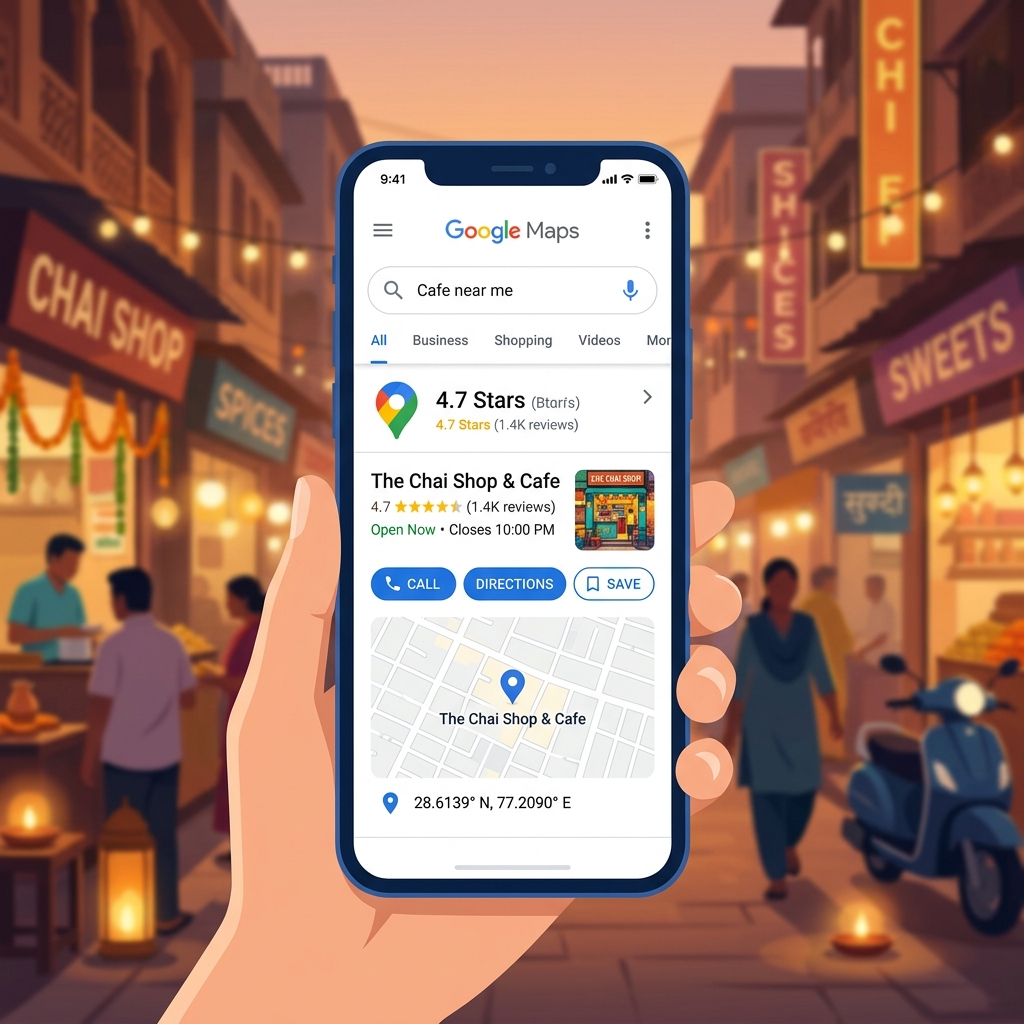
Picture this: someone in your city searches "best salon near me" or "dermatologist in Ahmedabad" on their phone. Google shows them a list of three businesses at the top — complete with photos, star reviews, location map coordinates, and a direct call button. Those three businesses are getting phone calls, booking inquiries, and walk-ins from that single search.
Is your business one of them?
For most small businesses across India, the honest answer is no — and it has nothing to do with the quality of their service. It is simply because they have not set up the right digital foundations to be found locally on Google. That is exactly what local search optimization fixes.
In this guide, we will walk you through every step of Local SEO for small businesses India — from the basics that most business owners have never heard of, to the advanced tactics that separate businesses that dominate their local search results from those that are invisible online. We will show you how to build a rock-solid foundation to attract customers who are ready to buy today.
What is Local SEO and Why Does It Matter for Your Business?
Local SEO (Search Engine Optimisation) is the process of optimising your online presence so your business appears in Google search results when people nearby search for the products or services you offer. Unlike regular SEO, which focuses on national or global search terms, local search targeting focuses on capturing geographic intent.
Let's look at the difference. If someone searches "best accounting software," that is a national query. Anyone in Surat, Surat's suburbs, or even London could search this, making the competition fierce. However, if a user searches "CA firm in Surat" or "hair salon in Bandra," they have a specific geographic intent. They are looking for a physical business to visit or hire in their immediate vicinity. This makes local search queries highly focused, less competitive, and much easier to rank for.
This matters immensely in India. India has over 750 million smartphone users, and the vast majority use their phones to locate nearby shops, clinics, and restaurants. In fact, "near me" searches in India have grown by over 150% in the last three years alone. Furthermore, Tier 2 and Tier 3 cities are experiencing an explosion in local searches as digital payments and connectivity spread. Local searches are the highest-quality leads you can get because they represent consumers who are already at the bottom of the buying funnel.
Our Direct Experience:
In our work building websites for clinics, salons, consultants, and restaurants across India, Local SEO India is consistently the area where small businesses have the most untapped opportunity — and the most to gain from getting the basics right. We have seen local listing updates double customer inquiries in as little as 30 days.
What to do:
Understand that local search engine optimization is not an option; it is your digital storefront. To get started, map out the primary search terms your local customers would use to describe your service combined with your city name.
Step 1 — Set Set Up and Optimise Your Google Business Profile
Your Google Business Profile (formerly Google My Business or GBP) is the single most important tool in your Local SEO toolkit. It is the free business listing that appears at the top of Google search results and on Google Maps when someone searches for your company or businesses in your industry.
Google Business Profile is the primary engine behind the "Local 3-Pack" — the top three local search results that Google features prominently above regular websites. Complete, verified listings receive over 70% of clicks for local terms, making it vital to establish and maintain an optimized profile.
To optimize your Google Business Profile India profile, you must claim and verify your physical address (usually via a Google postcard with a verification code, or a video check). Once verified, you must fill in every single field. Choose your primary business category with absolute precision, and add relevant secondary categories. Write a detailed business description that naturally includes your services and target city names.
You should also upload high-resolution photos of your storefront exterior, interior, and team. Google's data shows that listings with photos request 42% more directions than those without. Additionally, enable the direct messaging feature, add a menu or service list with prices, and publish regular updates using the GBP Posts feature to signal activity to Google's algorithms.
What to do:
Go to google.com/business and log in. Fill out all profile details to 100% completion, upload at least 10 high-quality photos of your business space, and verify your address. We handle this setup and optimization as standard during every website project we deliver.
Step 2 — Build Your Google Reviews Consistently
Google reviews are not just testimonials to help customers choose your services; they are a heavy ranking signal. Google's local algorithm prioritizes listings that have a high volume of reviews, high star ratings, and consistent, recent review activity.
In India, business owners face a specific challenge: happy clients rarely leave reviews on their own, while unhappy clients are highly motivated to write negative reviews. This means a fantastic clinic or restaurant can end up with a low rating simply due to a lack of volume. The only way to combat this is to make review collection a standard part of your business operations.
Create a direct Google review link from your GBP dashboard. Share this link with customers via WhatsApp immediately after a successful service, or set up a prominent QR code display at your reception desk or billing counter. Train your staff to ask for reviews as they conclude their service. Additionally, ensure you respond to every review professionally — both positive and negative. Google values active businesses that engage with their community.
What to do:
Generate your short Google review link, turn it into a QR code using a free generator, and display it at your business. Send a polite WhatsApp message with the direct link to your top 10 most loyal clients today, asking for their honest feedback.
Step 3 — Use Local Keywords Throughout Your Website
Google does not look at your Google Business Profile in isolation; it cross-references your listing with the contents of your website to verify your physical location and service areas. This is why using local keywords on your website is critical.
A local keyword is simply your core service combined with your city or area name. For example: "physiotherapist in Pune", "wedding photographer Jaipur", or "chartered accountant Ahmedabad". Without these location tags on your pages, search engine algorithms cannot confidently match your website to local searchers.
Ensure your primary local keyword is included in your page titles, meta descriptions, and main H1 headings. Write about your city, the neighborhoods you serve, and local client case studies on your About Us page. Place your full physical address, phone number, and a Google Map embed in your website's footer. If your business serves multiple distinct cities, the best practice is to create dedicated location pages (e.g., `/dentist-surat` and `/dentist-ahmedabad`) rather than trying to rank a single page for multiple locations.
What to do:
Audit your homepage. Ensure your city name and core service appear in the main headline (H1) and first paragraph. In our website projects, we perform keyword research to bake local terms into your page structure from day one.
Step 4 — Keep Your NAP Consistent Everywhere
NAP stands for Name, Address, and Phone Number. In Local SEO, consistency is everything. Google uses your NAP details to cross-verify that your business is legitimate, active, and located exactly where you claim it is.
If your business name is listed as "Karan Dental Clinic" on your website, but appears as "Karan Dental & Orthodontic Center" on Google Maps, and "Dr. Karan's Clinic" on Justdial, search engines get confused. Similarly, minor variations in your address format (e.g., using "Road No. 4" in one listing and "R.D. 4" in another) can dilute your local authority signals.
Inconsistent business listings are one of the most common and easily fixable Local SEO problems we find with new clients. Standardizing your business name, physical address, and contact numbers across all platforms helps search engines build a trusted, unified profile of your business.
What to do:
Write down your standardized business name, address, and phone number in a text file. Check your website, social profiles, and online listings, and update them so they match this master copy exactly, character for character.
Step 5 — List Your Business in Indian Online Directories
A local citation is any online mention of your business name, address, and phone number (NAP) on external websites and directories. Even without a direct backlink, these citations serve as votes of confidence verifying your location and industry relevance.
In India, there are several high-authority directories that you should prioritize. These directories have strong domain authority, meaning their listings often show up high in search results themselves, providing another way for customers to find you.
Ensure your business is registered on Justdial (India's largest local directory), Sulekha (great for service providers), IndiaMART and TradeIndia (vital for B2B and product businesses), Yelp India, and Bing Places. For industry-specific clinics, listings on Practo or Lybrate are essential. Salons should look at Urban Company, and restaurants must claim their Zomato and Swiggy pages. Facebook and LinkedIn business pages also count as high-value citations.
What to do:
Create a listing on Justdial and Sulekha using your standardized NAP details. The best practice is to claim existing, auto-generated listings first to prevent duplicate entries, which can confuse search engine algorithms.
Step 6 — Create Content That Targets Your Local Audience
Publishing articles and resources that focus specifically on local events, city news, or community stories is a powerful way to build local relevance. Hyperlocal content shows Google that your business is deeply rooted in your city.
For example, if you run a hair salon in Ahmedabad, you could write a blog post titled "How to Protect Your Hair from Ahmedabad's Hard Water." A local builder in Pune might write "A Guide to Property Registration in Pune (2026)." These topics target highly specific local searches that national competitors will never write about.
Additionally, you can publish client success stories highlighting local landmarks, share photos of local community events you sponsor, or build detailed local FAQ pages. Answering questions like "What is the cost of website design in Ahmedabad?" targets local voice searches and can earn you featured snippets at the top of search results.
What to do:
Identify three common questions your local customers ask in person. Turn these questions into detailed blog posts or FAQ sections on your website, using local names, locations, and landmarks in the text.
Step 7 — Add Local Business Schema Markup to Your Website
Schema markup is a structured data code added to your website header that helps search engines understand the context of your content. While humans cannot see this code, Google, Bing, and Apple Maps read it to parse your business details directly.
Think of it as giving Google a structured summary card of your business. By adding Local Business Schema, you tell search engines exactly what category you belong to (e.g., MedicalClinic, BeautySalon, LegalService), your geo-coordinates, operating hours, logo, and aggregate review ratings.
Implementing structured schema is a powerful differentiator. Most small business websites in India do not use schema markup, meaning adding it to your site code gives you an immediate technical advantage. It helps Google display rich snippets for your site (such as review stars and opening hours) directly in search results, boosting click-through rates.
What to do:
Use Google's free Structured Data Markup Helper to generate your JSON-LD schema code. Test the code using Google's Rich Results Test tool. As a best practice, you should ensure your web developer integrates this schema during every custom website build.
Step 8 — Make Sure Your Website is Mobile-Friendly
The vast majority of local searches in India happen on mobile devices. Customers are often on the move — searching for a "clinic near me" or a "cafe in Indiranagar" while driving or walking. If your site loads slowly or is difficult to read on a mobile screen, visitors will leave instantly.
A slow mobile experience leads to high bounce rates, which tells Google your website is not providing a good user experience, causing your local rankings to drop. Mobile responsiveness is a core requirement for modern Local SEO.
Every website we build is designed mobile-first from day one to ensure fast load speeds and clean navigation. To learn more about why responsive structure is essential for local business growth, check out our guide on How Mini Websites Fuel Local Retail Sales.
What to do:
Open your website on your phone. Can you easily click buttons without zooming in? Does it load in under 3 seconds on a standard mobile connection? If not, it is time to optimize your layouts and compress your image files.
Step 9 — Build Local Links to Strengthen Your Authority
A backlink is a hyperlink from an external website to yours. While general backlinks build your overall search authority, local backlinks (links from websites located in your target city or region) build your geographic authority.
Local link building is one of the most underutilized strategies in India, making it an excellent opportunity to stand out. Google views a link from a respected local news site, a local chamber of commerce, or a partner business in your city as a strong indicator that you are a trusted local operator.
You can build local backlinks by registering with local business groups (like BNI India, Rotary Clubs, or local trade associations), sponsoring local community events or school programs, partnering with complementary local businesses for cross-promotions, or contributing guest articles to local news portals and city blogs.
What to do:
Contact a local business partner or supplier you work with. Suggest writing a short testimonial for their website in exchange for a link back to your business, establishing a mutually beneficial local connection.
Step 10 — How to Track Whether Your Local SEO is Working
You cannot manage what you do not measure. Tracking your local search progress is essential to understand which activities are driving customers to your business and where you need to adjust your strategy.
Fortunately, you do not need expensive software. You can track your performance using free tools provided directly by Google. Your Google Business Profile dashboard features an "Insights" tab showing how many users viewed your listing, requested directions, called you, or sent a message, along with the exact search terms they used.
Use Google Search Console to monitor organic search impressions and clicks for local terms, and Google Analytics to track local referral traffic. Review these metrics monthly to monitor your new reviews, keyword positions, and contact form enquiries to measure your return on investment.
What to do:
Set up a simple monthly spreadsheet. Record your total Google Maps views, phone clicks from Google, website clicks from search, and new reviews. Tracking these numbers monthly keeps your local growth on track.
Complete Local SEO Basics Checklist
Use our interactive checklist below to audit your business's local search presence. Click the checkboxes to track your progress as you build your Local SEO foundation.
Local SEO Basics Audit Checklist
Google Business Profile
Reviews & Website
NAP & Citations
Technical & Tracking
Note: The checklist state is maintained in your browser as you click, allowing you to use this page as a live tool.
Your Local Customers Are Searching — Make Sure They Find You
Local SEO is not a one-time task — it is an ongoing process of building your online presence, earning trust, and staying visible to the customers in your area who are actively searching for what you offer.
The good news is that for most small businesses across India, the basics are still not being done properly — which means that getting even the foundational steps right puts you significantly ahead of your local competition.
Whether you run a clinic in Mumbai, a salon in Ahmedabad, a consultancy in Bangalore, or a restaurant in Surat — the opportunity to grow through Local SEO is real, and it is available right now.
We include essential Local SEO setup as part of every website project we deliver — Google Business Profile optimisation, review strategy, local keyword integration, and more — because a website that cannot be found locally is not working hard enough for your business.